Sign up for our email newsletter to receive in-depth, independent reporting that illuminates our region.
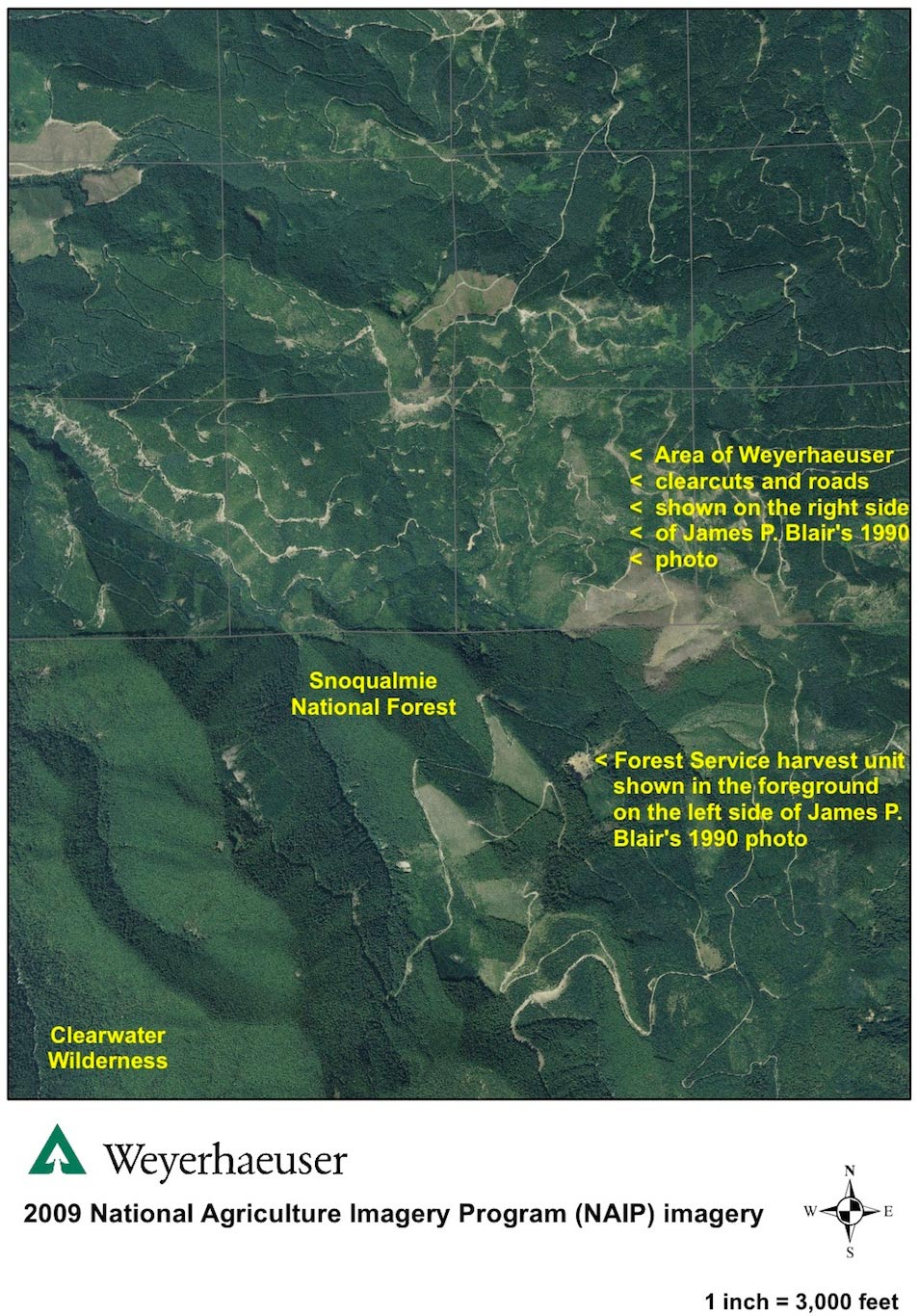
Rich Wininger, a Weyerhaeuser manager in the Northwest, recently wrote us in response to our Nov. 9 feature story “Roadless-less“, which included a photo of clearcutting on Weyerhaeuser forest lands (unfortunately we don’t have permission to reproduce that photo on our Web site).
I noticed the page 18 photograph of Weyerhaeuser lands adjacent to National Forest lands. I did not recognize the area, so I requested background information on it from our planners. My impression of High Country News is that you use current information, so I was surprised to learn that this photograph is 20 years old (copyrighted in 1990). (NOTE: After receiving Rich’s letter, HCN researched this photo. Getty, the photo service from which we licensed the image, had filed it with a 2006 date, but National Geographic, which originated the photo, says it was actually taken on August 26, 1989.)
A lot has changed in our forest management practices since 1990. Prior to 1992, there were only minimal buffers on fish-bearing streams. Watershed analysis was adopted into regulation in Washington in 1992 to protect public resources (such as fish, water, and capital improvements of the state) from the cumulative effects of forest practices. Most of the watershed analysis prescriptions were superseded by the Forest and Fish Law in 2001. That law required minimum 80 to 100 foot buffers on all fish streams and 50 foot buffers along ~50% of the length of perennial non-fish streams.
In addition, Washington wildlife tree, green-up, maximum clearcut size and improved road construction rules were enacted or expanded in the early 1990s. Pulling all of that together, this photograph is not an accurate portrayal of our practices, or of those lands today. The below aerial photo gives a more current view of the property you showed on page 18.
Concerning your article on roadless areas, my view is that public and private lands have different roles to play in our society. I’ll give you an example, I am attaching a photo taken on March 24, 2005, just a few months shy of 15 years after the 1980 Mt. St. Helens eruption. The Douglas-fir on the left side were planted in 1983 by Weyerhaeuser; the lands on the right side were set aside in the National Volcanic Monument to watch and learn about natural restoration processes. As you can see in the photograph, in the blast zone Weyerhaeuser lands have been reforested much faster than what you would find with natural processes. Which land management practice is right and which is wrong? That’s easy, both are right; they are different because we are serving different needs and have different objectives. We clearly manage our lands for timber production while at the same time protecting public resources. National Monument and National Forest lands have different goals.
Our articles are available for republishing, but images are only available on a case-by-case basis. You can’t republish photographs or illustrations without written permission from High Country News and/or the photographer. Please reach out to syndication@hcn.org to request illustrations and photography for specific stories.
Republishing guidelines
Credit the author and High Country News - We prefer Author Name, High Country News at the byline. At the top of the story, if on the web, please include this text and link: “This story was originally published by High Country News.”
Check the image requirements - Images that are clearly marked CC or from federal agencies are in the creative commons and are available for republishing. Outside of this, you can’t republish photographs or illustrations without written permission from High Country News and/or the photographer. Please reach out to syndication@hcn.org to request more information.
Don’t change anything significant - Articles must be republished in their entirety. Revisions for house style or references to time (“yesterday” to “today”) are allowed. If larger revisions are necessary, including significant trims or an editor’s note, contact us at syndication@hcn.org to get approval for the change ahead of republishing.
Share on social media - When sharing on social tag High Country News in your post and note the story is from @highcountrynews
Stay in touch - Let us know you republished the story. Send a link to syndication@hcn.org once you’ve republished the story and let us know how it’s resonating with your readers.
The picture of forest health
by Jodi Peterson, High Country News December 17, 2009