Sometimes old ideas become new ideas.
On July 9, Colorado Gov. Bill Ritter announced plans to seek federal funding to study a high-speed rail corridor from Denver south through New Mexico to El Paso, Texas.
Take out the “high-speed” part of it, and you’ve got the dream of Gen. William Jackson Palmer in 1870 — to go south from Denver to the Rio Grande valley (thus the name of his Denver & Rio Grande Railroad) to El Paso, where it would connect with Mexican lines.
Palmer’s railroad (absorbed by the Union Pacific in 1996) did reach the Rio Grande, but never went south of Santa Fe. His preferred route, over Raton Pass, was blocked because the Atchison, Topeka & Santa Fe Railroad got there first. And the 1879 silver bonanza of Leadville turned Palmer’s attention to a different direction.
So the line became the Denver & Rio Grande Western, and evolved into an east-west link rather than the original north-south route.
About 60 years ago, in an introduction to a book called Cities of the West, Carey McWilliams observed that even though the mountain ranges of the West trend north-south, the major transportation corridors oppose this geography by running east-west.
In the view of McWilliams (who grew up on a ranch near Steamboat Springs, Colo., and went on to edit the Nation magazine after a productive literary career in California), the West’s transportation network was aligned to serve national needs, rather than regional needs. The railroads that got the land grants — that is, the government support of the era — were east-west lines.
In the formative years of the American West during and after the Civil War, the national government wanted the West Coast tied to the Midwest. Some north-south corridors that tied Helena to Phoenix might have encouraged a regional economy and identity — and after four years of bloody civil war, another regional culture may have been the last thing the United States wanted or needed.
The pattern persists to this day. It’s easier to catch a plane from Denver to Philadelphia or Los Angeles than it is to fly to Boise or Helena.
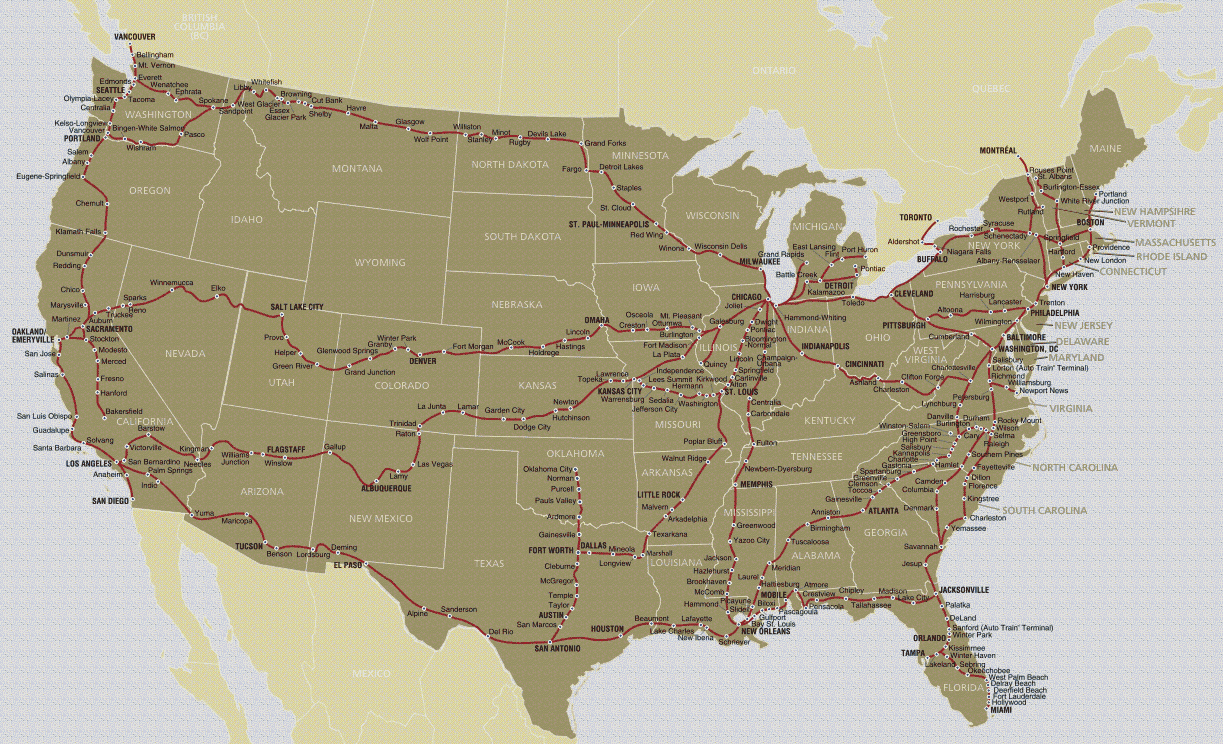
Or take a look at a modern Amtrak map, which reflects certain contemporary national transportation priorities. It shows four east-west corridors. As for north-south routes, there’s one along the West Coast, and another from Minneapolis through Chicago to New Orleans. But there’s nothing in between, out where we live.
So if Colorado Gov. Ritter and his colleagues, Bill Richardson of New Mexico and Rick Perry of Texas, manage to get federal support for a north-south corridor in the West, they’ll accomplish something new — or something as old as Gen. Palmer’s plan of 1870.